


Blade Signs for Long Island Downtowns: Sizes, Lighting and Village Rules
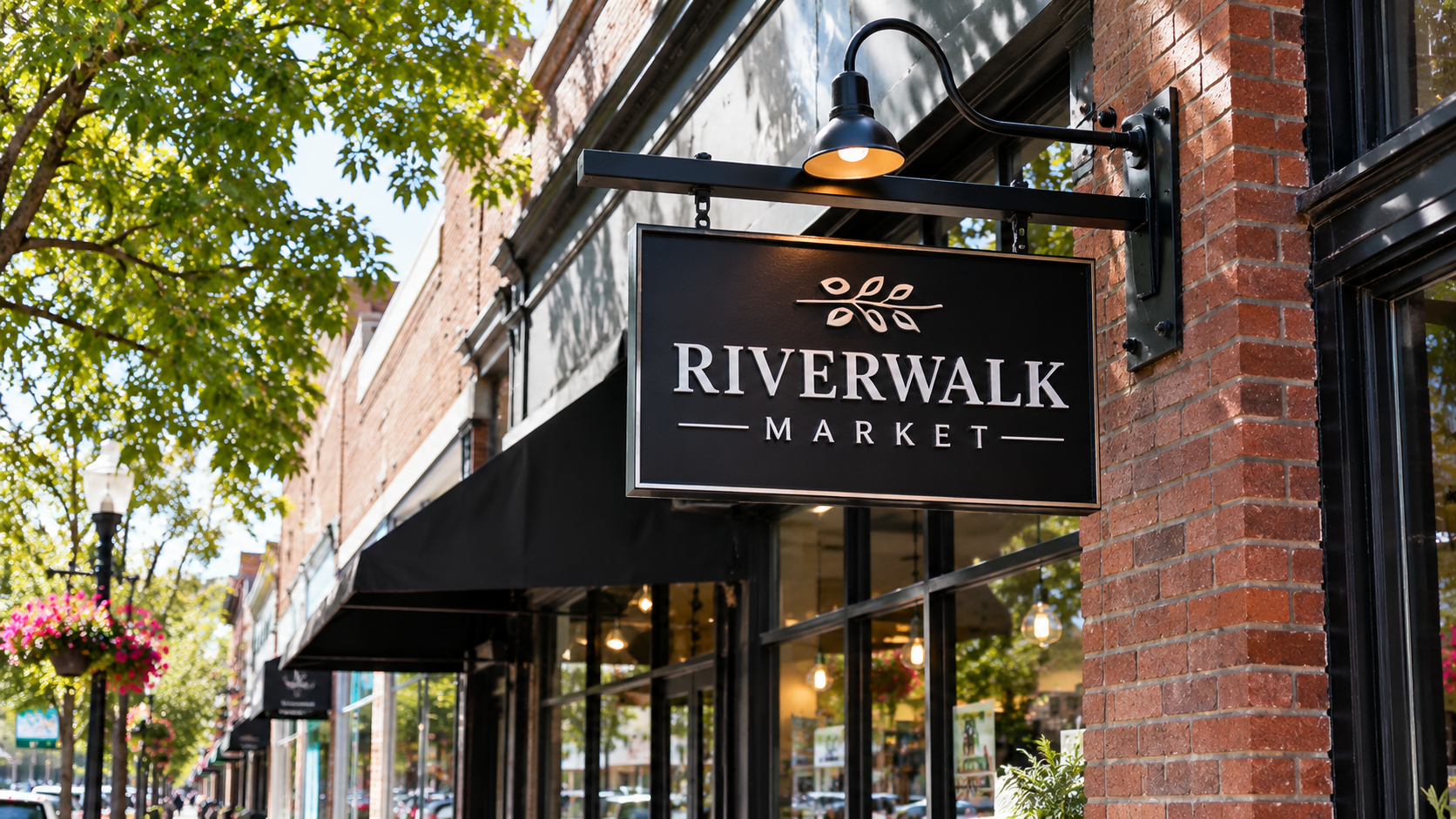
What should a Long Island business owner consider before ordering a blade sign?
Choose a blade sign that can be understood in three seconds, fits the building’s scale and complies with local projection, clearance and lighting rules. Confirm approval requirements before fabrication, then use a bold logo, short business name and high-contrast colors to make the sign readable to pedestrians approaching from either direction.
Blade signs project perpendicular to a building façade, placing the sign face directly in the sightline of people walking along the sidewalk. That makes them particularly effective for restaurants, boutiques, salons, professional offices and other businesses in Long Island’s walkable downtowns.
Their apparent simplicity can be deceptive. An effective blade sign must balance visibility, architectural fit, structural support and local rules. The best result is not necessarily the biggest or most elaborate sign. It is the sign pedestrians notice, recognize and remember before they pass the entrance.
Successful blade signs communicate in three seconds
Pedestrians usually see a projecting sign while moving toward it rather than standing directly in front of it. Too much information forces them to choose what to read—and often means they read nothing.
Empire Sign & Design recommends a disciplined approach:
“Keep it ultra-simple, design for a 3-second glance. Pedestrians only glance at a projecting sign for two or three seconds. Stick to a bold logo/icon, your business name, and high-contrast colors. Skip taglines, websites, and phone numbers.”
A strong blade sign generally includes:
- A recognizable logo or simple icon
- The business name in a legible typeface
- Strong contrast between the lettering and background
- Adequate blank space around the message
- The same core identity on both visible sides
Fine print, service lists, phone numbers and web addresses belong on windows, doors or other supporting graphics—not on a sign viewed briefly and at an angle.
The right size depends on the storefront and viewing distance
There is no universal best size for blade signs. The correct dimensions depend on the width and height of the façade, mounting location, sidewalk width, surrounding signs and local projection limits.
For a compact downtown storefront, a modest square, round or vertically oriented panel may provide sufficient visibility without competing with the architecture. A larger façade or deeper setback may require more sign area, but increasing size does not correct weak contrast or crowded typography.
Use this practical sizing sequence:
- Identify the primary approach paths. Determine where pedestrians first see the storefront from each direction.
- Measure the usable mounting area. Account for windows, trim, utilities, awnings and neighboring storefront elements.
- Check projection and clearance limits. The bracket and panel must remain within applicable local requirements.
- Test the design at its expected size. A logo that works on a screen may lose detail when fabricated.
- Review the complete storefront. The blade sign should complement—not duplicate or overpower—the main façade sign.
Businesses considering a coordinated sign package can pair a blade sign with professionally designed storefront signs on Long Island so the building works for both sidewalk and street-level visibility.
Local approval must come before fabrication
Blade signs extend away from the building, which means their projection, mounting position and clearance can receive closer scrutiny than flat wall signs. Requirements may differ among Long Island municipalities and incorporated villages, including downtown areas such as Great Neck, Mineola and Port Washington.
Depending on the property and jurisdiction, the approval process may address:
- Maximum sign area and projection
- Minimum clearance above the sidewalk
- Placement relative to doors, windows and property lines
- Number of signs allowed per tenant or façade
- Illumination type and operating restrictions
- Historic-district or architectural-review standards
- Structural attachment details
- Landlord or property-management approval
Do not assume that a nearby business’s sign establishes what your property can install. Its sign may have been approved under different rules, installed before current standards or granted a specific exception.
Planning a blade sign for a Long Island storefront? Ask Empire Sign & Design to evaluate the location before production. A site-specific review can align the design, materials, mounting method and approval path early—protecting both quality and schedule. Businesses seeking broader local support can also work with a Long Island sign company for coordinated design, fabrication and installation.
Lighting should improve recognition without adding clutter
Illumination can extend a blade sign’s usefulness after dark, but the lighting method should fit the storefront and local setting.
| Lighting approach | Best suited for | Primary consideration |
| Non-illuminated | Daytime businesses and well-lit downtown blocks | Relies on strong contrast and existing ambient light |
| External illumination | Traditional storefronts and architectural settings | Fixture placement must light the face evenly |
| Internally illuminated | Businesses needing stronger evening visibility | Cabinet depth, electrical access and local rules must be considered |
| Halo or specialty lighting | Premium applications with suitable fabrication | Works best with simple forms and controlled brightness |
Lighting should make the name easier to recognize, not create glare. Electrical routing, service access and sign depth should be resolved during design rather than improvised during installation. Businesses needing greater nighttime visibility may also compare blade signs with illuminated signs for Long Island storefronts.
Materials and mounting determine long-term performance
An exterior blade sign is exposed to wind, rain, temperature changes and constant movement around the storefront. The sign face, bracket, fasteners and wall attachment therefore need to function as a complete exterior system.
Common material choices include aluminum, fabricated metal, acrylic and routed composite panels. The best option depends on the desired appearance, sign size, lighting method and mounting conditions.
Before approving a design, verify:
- The wall or façade can support the proposed assembly.
- The bracket is proportioned for the sign’s size and weight.
- Exterior finishes are appropriate for weather exposure.
- Fasteners and attachment points suit the underlying wall material.
- Electrical components remain accessible for maintenance.
- The installation will not interfere with doors, awnings or pedestrian clearance.
Quality fabrication matters, but so does timely coordination. Discovering an unsuitable wall condition or approval issue after production can delay an opening and require avoidable modifications.
A pre-production checklist prevents expensive revisions
Before authorizing fabrication, confirm all six items:
- [ ] The name and logo are readable in a three-second glance.
- [ ] Both sign faces work for opposing pedestrian approaches.
- [ ] Dimensions fit the storefront and applicable local limits.
- [ ] Landlord and municipal approvals have been addressed.
- [ ] Materials, lighting and mounting hardware are coordinated.
- [ ] Installation access and electrical needs have been verified.
This sequence protects the design from becoming disconnected from the property’s real conditions.
Frequently Asked Questions
What is the difference between a blade sign and a storefront sign?
A blade sign projects perpendicular to the façade and is primarily viewed by pedestrians approaching from either side. A storefront sign is typically mounted parallel to the building and is easier to see from across the street or directly in front of the property. Many downtown businesses benefit from using both.
Should a blade sign include a phone number or website?
Usually not. Pedestrians have only a few seconds to process the message. A business name, bold logo or recognizable icon will generally perform better than contact details, a tagline or a service list.
Can a blade sign be illuminated?
Yes, blade signs can use internal or external illumination when the design, electrical conditions and local rules allow it. The lighting method should be selected before fabrication because it affects sign depth, materials, wiring and mounting.
Do blade signs require permits on Long Island?
Approval requirements depend on the municipality, incorporated village, property and sign design. Because blade signs project from a building, local review may address sign area, projection, sidewalk clearance, illumination and structural attachment. Confirm the applicable requirements before fabrication begins.
Back